
A chain is a consumable. It wears every time you ride, and if you leave it too long it takes the cassette and chainrings with it. The good news is that chains wear predictably, and a cheap tool tells you exactly when to act. This guide explains what chain wear is, the thresholds the whole industry uses, and the real cost of missing the window.
This is part of IKUISTA Tech Notes, our plain-language guides to the engineering behind the bike.
What chain wear actually is
People call it chain stretch, but the metal does not stretch. The pins and the inner surfaces of the chain wear, so each link grows a little. Across many links that adds up, and the chain's pitch grows beyond its original 0.5 inch (12.7mm) spacing.
A new chain sits deep in the cassette teeth. As the pitch grows, the chain rides higher on the teeth and contacts fewer of them. Load concentrates, and the harder steel of the chain grinds down the softer cassette. Left long enough, the chain skips under load.
The thresholds the industry uses
Wear is measured as a percentage of growth over a 12 inch span. Three numbers matter.
At 0.5 percent, the chain has grown about 1.5mm over that span. For 11, 12, and 13 speed drivetrains, this is the replacement point. The narrow spacing of modern cassettes is less forgiving, so you replace early.
At 0.75 percent, growth is about 2.3mm. This is the replacement point for 8, 9, and 10 speed chains, and the immediate-replacement line for everyone. Past it you risk the cassette.
At 1.0 percent, the chain is worn out and a new cassette is likely needed with it.
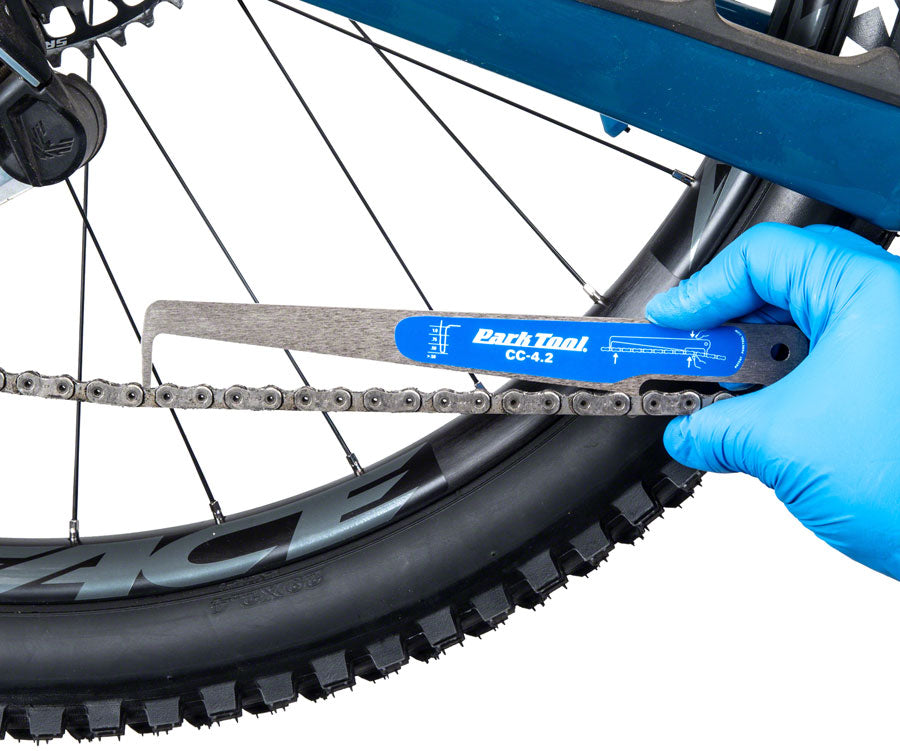
A chain checker tool is the easy way to read this. It drops into the chain and gives a go or no-go result at 0.5 and 0.75 percent. The tool costs little and takes seconds. Measure on the lower run of chain, let the tool sit under its own weight, and do not press it down, since forcing it gives a false worn reading. A ruler works too: measure 12 inches across the links, and more than 1/16 inch over means it is time.
The cost of waiting
This is where the numbers get persuasive. A chain is one of the cheaper parts on the bike. A cassette costs several times as much, and on high-end groupsets the gap is large. If you replace the chain on time, you can run several chains through the life of one cassette. If you wait until the chain is badly worn, the worn chain reshapes the cassette teeth, the new chain then skips on them, and you end up buying a chain and a cassette together, sometimes chainrings too.
So the maths is simple. A small tool and a one-minute check, done regularly, save you the price of a drivetrain.
How to make a chain last
Chain life depends far more on cleanliness than on brand. Grit acts like a grinding paste between the pins and rollers, so a dirty chain wears fast. Clean and lubricate regularly, and wipe off excess lube that would only attract more dirt. In good, dry conditions with regular care, a road chain often lasts in the region of several thousand kilometres. In wet, gritty conditions it wears far quicker, which is why distance alone is a poor guide. The only reliable answer is to measure.
Your drivetrain layout affects wear too. Our guide to 1x and 2x drivetrains explains why chainline and sprocket size matter, and the bottom bracket standards guide covers the other half of the drivetrain.
The IKUISTA approach is built around exactly this kind of upkeep. Standard chains and cassettes, sized so any shop can service them, and a maintenance habit that costs little and saves a lot.
Your turn
Do you check your chain on a schedule, or replace it when something starts to feel off? Tell us in the comments how many chains you get through one cassette. If you want help choosing a chain checker or reading a wear measurement, get in touch.
Frequently asked questions
At what wear should I replace my chain?
Replace 11, 12, and 13 speed chains at 0.5 percent. Replace 8, 9, and 10 speed chains at 0.75 percent. Past 1 percent you usually need a new cassette too.
How do I measure chain wear?
Use a chain checker dropped into the lower run of chain, or measure 12 inches across the links with a ruler. More than 1/16 inch of growth over 12 inches means replace.
How long does a chain last?
It depends on conditions and cleaning. In dry conditions with regular care a road chain can last several thousand kilometres. In wet, gritty riding it wears much faster, so measure rather than count distance.
Why replace the chain so early on 12 speed?
The narrow cog spacing of 11 to 13 speed cassettes is less forgiving of a grown chain, so a 0.5 percent threshold protects the more expensive cassette.
Will a new chain fix skipping on an old cassette?
Often no. If the cassette is already worn to match a stretched chain, a new chain skips on it, and you need to replace both.
Compare all four IKUISTA models
Vektori · Fluxi · Spektri · Halo
Share:
Headset Standards and IS52: How to Read the Code on Your Bike
Tyre Width and Pressure: What Is Actually Fastest