
Few parts cause more frustration than the bottom bracket. Threaded, press-fit, BB30, PF30, BB86, T47. The names sound like noise, and a creaking one can drive you to distraction. This guide cuts through it. We explain what each type is, why some creak, and what to choose if the choice is yours.
This is part of IKUISTA Tech Notes, our plain-language guides to the engineering behind the bike.
What a bottom bracket does
The bottom bracket holds the bearings that let the crank spin. It sits in the frame's bottom bracket shell. The standards differ in how those bearings attach to the frame: threaded in, or pressed in.
Threaded (BSA)
The traditional threaded standard is BSA, a 68mm shell with 1.37 inch by 24 TPI threads, reverse threaded on the drive side. The cups thread directly into the frame.
The advantage is tolerance. Threads give the system room to absorb small manufacturing variations, so the bearings stay aligned. Removal and fitting need only standard tools, and a properly greased threaded cup rarely creaks because it cannot move. The main downsides are a little more weight and a smaller shell diameter than oversized press-fit designs.
Press-fit (BB30, PF30, BB86, BB92)
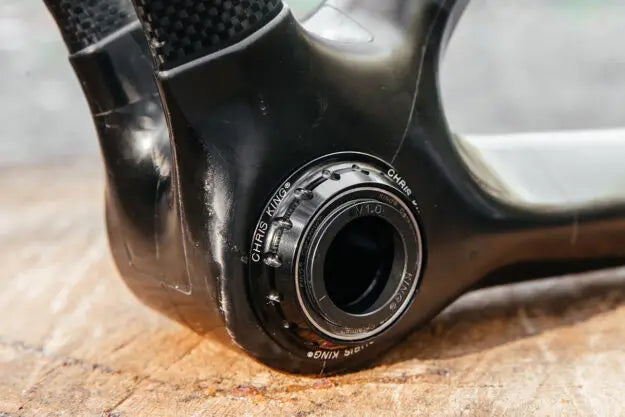
Press-fit standards came from manufacturing convenience. A large, smooth bore is easier to produce than precision threads, and it allows a bigger bearing and spindle, which can mean a stiffer, lighter junction. The bearings, or cups holding the bearings, press straight into the shell.
The problem is tolerance stacking. Frame shell tolerances combine with cup tolerances, and in a worst case the cup fits slightly loose, micro-moves under pedalling load, and creaks. Threadlock and carbon paste treat the symptom. Tighter-tolerance cups treat it better. The point is that the creak comes from the fit, not from the rider.
It is worth being fair here. A press-fit frame built to good tolerances, by a builder who holds them, can be silent for years. The reputation for creaking comes from frames that miss those tolerances, not from the idea itself.
T47
T47 is the recent answer. It is, in effect, a threaded version of PF30: a 47mm shell with an M47 by 1mm thread. It keeps the large diameter and bearing options of press-fit, while the cups thread into the frame instead of pressing in. That brings back the security and quiet of threads. T47 also adapts to many crank spindle types and shell widths, which is why custom builders and a growing list of brands have adopted it.
The honest caveat is that putting threads into a carbon frame adds material and machining steps, so not every maker uses it, and a well-made press-fit frame is not automatically worse.
What to choose, if the choice is yours
For a new bike where you can pick, the simple priority is serviceability. A threaded standard, BSA or T47, threads in, stays put, and comes apart with normal tools. That is the low-drama choice.
If you already own a press-fit frame, it is not a problem to be feared. Keep it clean, have it fitted with good-quality, tight-tolerance cups, grease or paste the interface correctly, and most creaks never appear. If one does, a threaded adapter cup can convert a troublesome press-fit shell to BSA permanently.
One more practical note. A creak near the bottom bracket is not always the bottom bracket. Pedals fitted without a washer, dry pedal threads, a loose cassette, or seatpost and saddle hardware can all sound like they come from down there. Check the cheap things first.
The IKUISTA approach is to use standard, serviceable interfaces that any competent shop can work on with normal tools, and to be honest about what actually causes noise.
Your turn
Threaded or press-fit on your current bike, and has it ever creaked? Tell us in the comments what finally silenced it. If you are weighing a frame and want to understand its bottom bracket before you buy, get in touch.
Compare all four IKUISTA models
Vektori · Fluxi · Spektri · Halo
Share:
UDH and Full Mount: The Rear Derailleur Standard, Explained
Hookless Rims: The Safety and Compatibility Facts