
Many rear derailleur problems start at one small part: the hanger. SRAM's Universal Derailleur Hanger, or UDH, set out to fix that. This guide explains what UDH is, what the hangerless Full Mount system that grew out of it does, and what both mean when you buy or service a bike.
This is part of IKUISTA Tech Notes, our plain-language guides to the engineering behind the bike.
The problem UDH solves
A derailleur hanger is the small bracket that joins the rear derailleur to the frame. For decades almost every frame used its own hanger shape. There were hundreds of them. If you bent or broke one, you had to find the exact match for your frame, often by mail order, often days away from your next ride.
The hanger also sets where the derailleur sits relative to the cassette. Small differences between frames meant shifting quality varied from bike to bike.
What UDH is
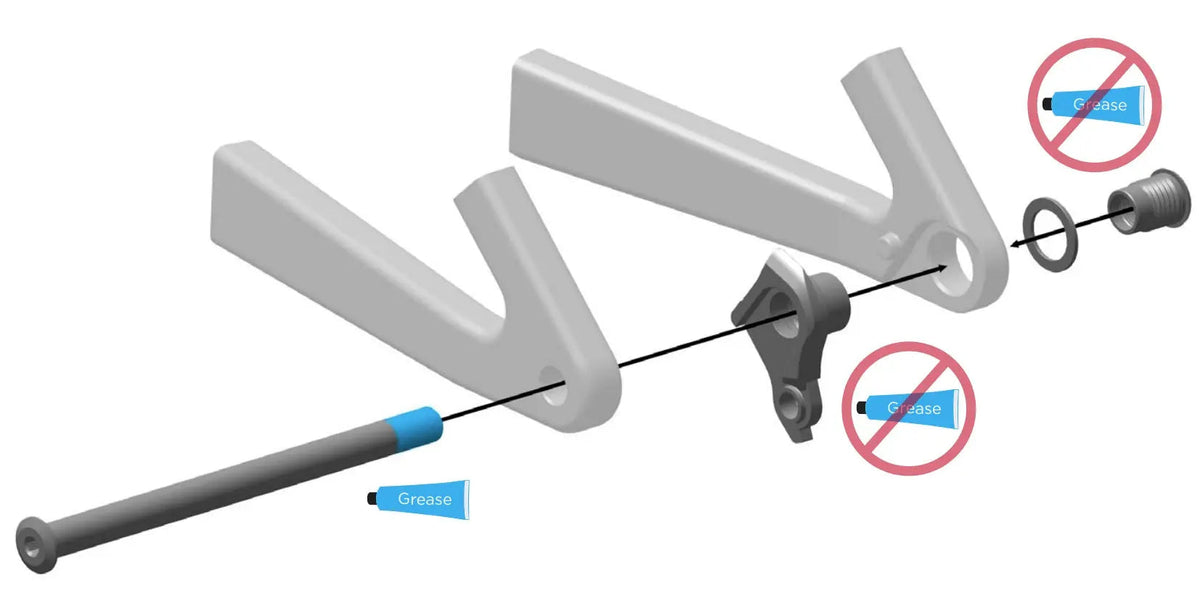
UDH is a single, shared hanger design. SRAM introduced it in 2019 and made it an open standard that any brand can use. One shape now fits a wide range of frames from many makers.
Two practical results follow. First, replacement is simple. A UDH is inexpensive and stocked widely, so a spare fits in a saddlebag and almost any shop can sort you out. Second, the derailleur sits in a consistent position, so setup is more repeatable across frames. SRAM points to fewer variables as the reason shifting improves.
UDH also has a safety feature. It is designed to rotate backward on a rear impact rather than snap, which reduces damage to the frame and derailleur. A hooked lip helps keep the chain from being dragged between the frame and the freehub if it drops off the bottom of the cassette.
From UDH to Full Mount
UDH did more than tidy up spare parts. Its shared interface gave a fixed mounting point referenced to the rear axle. That made a hangerless derailleur possible.
SRAM's Full Mount derailleur removes the hanger entirely. The derailleur attaches directly to the frame and clamps over the drive-side dropout, centring on the rear axle. Because the axle centre is the same reference for every drivetrain, the system can drop the limit screws and the B-tension screw. SRAM says this gives easier setup, better shifting under load, and more resistance to impacts. Full Mount covers both Eagle Transmission for mountain bikes and the RED, Force, and Rival XPLR groupsets for road and gravel.
A UDH frame is the entry ticket. If a bike is built to the UDH standard, it can run a normal derailleur on a UDH hanger today, or a Full Mount derailleur with no hanger later.
What it means when you buy or service a bike
A UDH frame future-proofs the rear end. You keep options open without changing frame, and the spare-hanger problem becomes trivial.
A few caveats are worth knowing. You can still run Shimano or Campagnolo derailleurs on a UDH frame, but a Shimano road or Shadow-style derailleur needs the B-link, or a UDH direct-mount hanger from a maker like Wheels Manufacturing. UDH was designed mainly around carbon and alloy frames with 12mm thru-axles. Some adjustable flip-chip dropouts do not work neatly with it. And the UDH bolt is reverse threaded and torqued to around 20 Nm, so it loosens clockwise and not every torque wrench runs both ways. If in doubt, have a shop fit it so the rearward movement works as intended.
The IKUISTA approach fits here. Shared, standard interfaces mean parts you can find anywhere and service at any competent shop. That is the opposite of a proprietary hanger you can buy from one brand only.
Your turn
Have you ever been stranded by a bent hanger you could not replace locally? Tell us in the comments. If you want to check whether a particular frame is UDH or Full Mount ready, get in touch and we will work through it with you.
Compare all four IKUISTA models
Vektori · Fluxi · Spektri · Halo
Share:
Ceramic Bearings: What the Independent Data Actually Shows
Bottom Bracket Standards: Threaded, Press-Fit, and T47, Explained