
Hookless rims are one of the most argued topics in road cycling. Some brands build only hookless, others only hooked, and a high-profile race incident kept the debate loud. This guide sets out the engineering facts, the hard pressure limit, the compatibility rules, and who each design actually suits.
This is part of IKUISTA Tech Notes, our plain-language guides to the engineering behind the bike.
Hooked and hookless, in plain terms
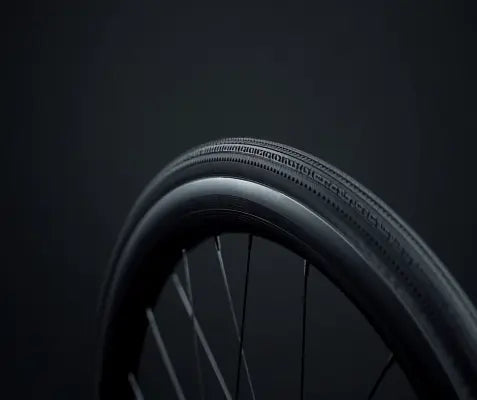
A hooked rim has a small inward lip at the top of the rim wall. When the tyre inflates, that hook catches the tyre bead and mechanically holds it. It has been the road standard for decades.
A hookless rim, also called tubeless straight side, has no hook. The inner walls are straight, and the tyre bead is held by air pressure pushing it against the wall, helped by tight tolerances between bead and rim. Removing the hook simplifies the carbon mould, saves a small amount of weight, around 10 to 20 grams per rim, and can make tubeless tyres easier to seat.
The pressure limit that matters
This is the heart of the matter. Under ETRTO and ISO guidance, the hard maximum pressure for a hookless road rim is 72.5 psi, or 5 bar, for nominal tyre sizes from 25 to 29mm. Larger tyres have lower limits, with 30 to 34mm rated to about 65 psi, or 4.5 bar.
This is not a cautious suggestion. It is a ceiling. Above it, with no hook to hold the bead, the risk rises that the tyre lifts off the rim. The retention test reflects this. A tyre on a hookless rim must hold 110 percent of the maximum pressure without blowing off, while a hooked rim is tested to 150 percent. In practice that leaves a much smaller margin for error on hookless.
Two everyday factors eat into that margin. Pump gauges are often off by several percent, so a pump reading 5 bar might be delivering more. And heat raises pressure, roughly 2.5 psi for every 10 degrees Celsius. Inflate in a cool garage, ride into a hot afternoon, and a tyre set near the limit can push past it.
Compatibility is not optional
On a hooked rim you can fit almost any tyre and run high pressure. On a hookless rim you cannot. The tyre must be hookless tubeless compatible and on the rim maker's approved list, and the tyre width must suit the rim's internal width. A wider internal rim requires a wider minimum tyre. Mixing a non-approved tyre, or the wrong width, raises the chance of the bead not seating correctly and of sudden unseating under impact.
It is worth noting that the well-known pro crash that fuelled the debate was later attributed to a hard impact that broke the rim, not to the hookless design itself. Once a rim structure fails, no system keeps the tyre on. The honest lesson is not that hookless is unsafe, but that it has a smaller margin and a stricter setup.
Who each design suits
Hookless rewards a rider who commits to the system. Wide tubeless tyres, modest pressures, an approved tyre, and an accurate gauge. That describes most gravel riding well, where tyres are 40mm and wider and pressures sit far below the limit. There, hookless makes good sense.
Hooked is the more forgiving choice for road. It accepts tubeless, tubes, and clinchers, allows higher pressures, and gives a larger safety margin. For a rider who runs narrower tyres at higher pressure, who is heavier, or who simply wants tyre freedom, hooked remains the lower-risk standard.
The IKUISTA approach is to be straight about this. The right rim depends on how you actually ride, the tyre you run, and the pressure you need. A wheel choice is a system choice, not a free upgrade, and safety margin is part of the spec.
Your turn
Are you on hooked or hookless, and what tyre and pressure do you run? Tell us in the comments, and whether you have checked your pump against a digital gauge lately. If you want help deciding which suits your riding, get in touch.
Compare all four IKUISTA models
Vektori · Fluxi · Spektri · Halo
Share:
Bottom Bracket Standards: Threaded, Press-Fit, and T47, Explained
Headset Standards and IS52: How to Read the Code on Your Bike