
A drivetrain choice changes how your bike rides every time you pedal. 1x and 2x are the two main layouts. This guide explains how they differ, what the research says about efficiency, and how to pick the right one for your riding. We keep it practical. We are also honest about where the differences are small.
This is part of IKUISTA Tech Notes, our plain-language guides to the engineering behind the bike.
What 1x and 2x actually mean
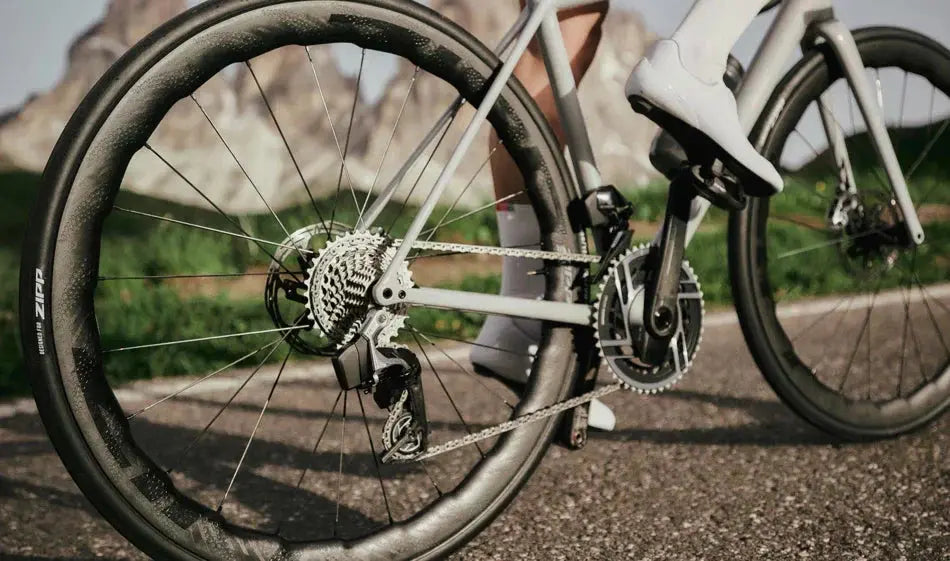
2x means two chainrings at the front, a front derailleur, and a front shifter. You change the front ring for big jumps in gearing and the rear cassette for fine steps.
1x means one chainring, no front derailleur, and no front shifter. All your shifting happens at the rear cassette.
Your total gear range comes from two things: the chainring size or sizes, and the spread of the cassette. 2x gives a wider total range with smaller steps between gears. 1x is simpler with fewer parts, but the steps between gears are larger unless you run a very wide cassette with many cogs.
What the efficiency research shows
The most cited study here is from Johns Hopkins University (Spicer et al., 2001), funded by Shimano. The researchers measured a bicycle chain drive at up to 98.6 percent efficiency in the best case and about 81 percent in the worst. You can read the plain-language summary from Johns Hopkins here.
Two factors raised efficiency. The first was sprocket size. Larger sprockets were more efficient, because the chain links bend at a smaller angle as they wrap the gear, so less frictional work is done. The second was chain tension. Higher tension scored higher efficiency. Lubrication made no measurable difference in clean lab conditions. Its real job is keeping dirt out of the chain, which matters outdoors.
A straight chainline tested as the most efficient setup. The more the chain runs at a sideways angle, the more frictional work it does.
Now apply that to 1x and 2x.
Larger sprockets are more efficient. A 1x setup often pairs a small chainring with a wide cassette. At speed you can end up on a small chainring and a small cog, two small sprockets at once, which the data links to slightly higher losses. A larger chainring keeps the chain on larger effective sprockets.
A straight chainline is more efficient. A 1x uses the full width of the cassette, so the extreme cogs sit the chain at a larger sideways angle. A 2x lets you choose the chainring that keeps the chain closer to straight more of the time. A 2x has its own cross-chaining to avoid, in the big ring with the biggest cogs and the small ring with the smallest cogs.
Here is the honest caveat. These differences are small. A clean, well adjusted drivetrain in either layout is efficient. Chain wear, dirt, and lubrication in real conditions usually matter more than 1x versus 2x. Keep the chain clean and replace it before it stretches. The same point about clean, well-set-up parts applies to bearings, which we cover in ceramic bearings: what the data shows.
For a broader survey of the engineering, the 2025 review in the journal Machines, Power Transmission Mechanism and Tribological Performance of Modern Bicycle Drivetrains, collects the published work in one place.
Where 1x wins
Fewer parts. No front derailleur and no front shifter. Less to adjust, less to fail, less weight.
Simpler shifting. One shifter and one decision under pressure.
Good chain retention. A narrow-wide chainring and a clutch rear derailleur hold the chain well on rough ground.
Best suited to gravel, cyclocross, commuting, and riders who want low maintenance.
The trade-off is larger jumps between gears, or a very wide cassette that increases chain angle at the extremes.
Where 2x wins
Wider total range with smaller steps. You can hold a steady cadence on long efforts.
A high top gear and a low climbing gear can coexist with close ratios.
Best suited to road, endurance, and tarmac racing.
The trade-off is more parts, a little more weight, front shifting to manage, and a chainline to think about.
A simple way to decide
| Riding | Likely better choice | Why |
|---|---|---|
| Road and endurance, long steady efforts | 2x | Close steps, wide range, steady cadence |
| Fast mixed-surface gravel | 1x or 2x | Depends on terrain. 1x for simplicity |
| Bikepacking, steep loaded climbs | 2x or very wide 1x | A low gear without huge jumps |
| Cyclocross, short and punchy | 1x | Simplicity and chain retention |
| Commuting, all weather | 1x | Low maintenance |
| Tarmac racing | 2x | Close ratios for cadence control |
Not sure where your riding sits? Our Bike Finder matches a setup to how and where you ride. You can also browse the current range here.
Chainline and cassette range, in plain terms
Chainline is how straight the chain runs from front to back. The straighter it runs, the less frictional work it does. Choose gears that avoid the steepest cross-chain. On a 2x, that means the big ring with the larger cogs, and the small ring with the smaller cogs, not the extremes.
Range is the chainring ratio range multiplied by the cassette range. A wide 1x cassette, for example 10-44 or 10-52, chases the range of a 2x, but with larger steps between gears.
More cogs help. A 12 or 13 speed cassette narrows the steps on a wide cassette. That is the main reason 1x has become viable for more riders.
The standards behind 1x
1x has driven new mounting standards. SRAM's Universal Derailleur Hanger and the Full Mount, hangerless approach put the rear derailleur in a fixed, axle-referenced position. That improves shifting consistency and impact resistance for 1x systems. We cover that in a separate guide: What UDH and Full Mount mean for your bike.
The IKUISTA approach is the same across layouts. We use carefully selected, standard components, so any competent bike shop can service them. The drivetrain you choose should match your riding, not lock you into one supply chain.
Your turn
1x or 2x for the riding you actually do, and what terrain pushed you toward it?
Compare all four IKUISTA models
Vektori · Fluxi · Spektri · Halo
Share:
Crafting the Perfect Bike Journey: Exploring IKUISTA's Finnish Design Philosophy
Ceramic Bearings: What the Independent Data Actually Shows